
How Watlow Cut RFQ Time with AI Sourcing Agents
The drawing came down one at a time. The quote came back 45 to 60 days later. Two hundred and thirty-five parts had no partner at all.
ButterflyCopilot
0106
The drawing was one file. Then the next file. Then the one after that.
Watlow has been making industrial heat since 1922. Heaters, sensors, controllers. The pieces of a thermal system, for the plants that cannot afford a cold hour. Headquarters are in St. Louis. The case study counts 13 manufacturing sites and tens of thousands of active part numbers, across metallics, plastics, and advanced components. Watlow's own page says the company employs more than 4,200 team members.
The size is not the lesson. The lesson is a part number whose drawing, commodity code, and supplier history do not live in the same place.
The download was the job
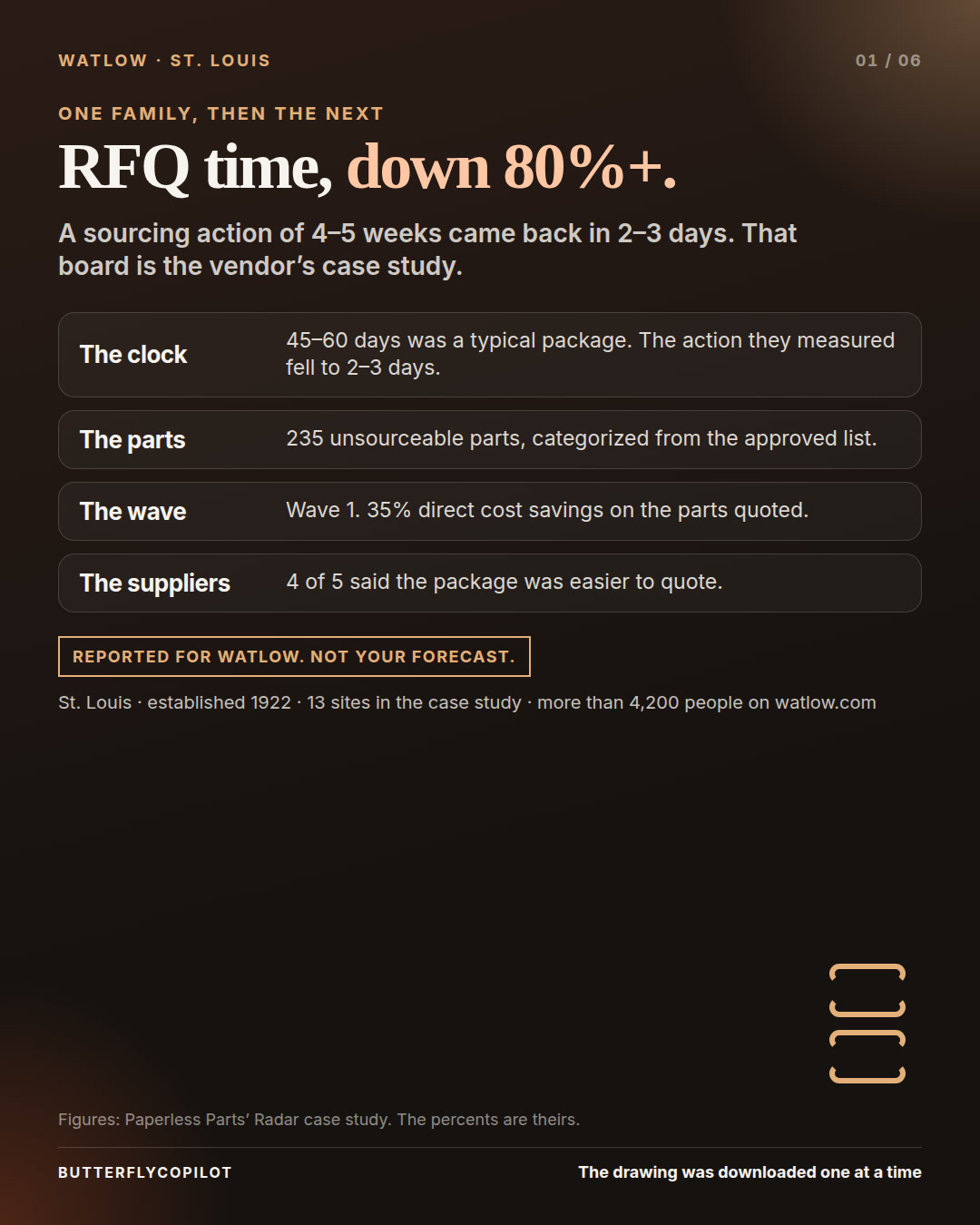
Liying Luplow was the project manager for global sourcing. She spent hours downloading every drawing, one at a time. A typical package, once it had gone out, took 45 to 60 days to come back. Limited coverage on those quotes delayed revenue and raised the material cost. Two hundred and thirty-five parts sat idle. The team called them unsourceable, because nobody could see which approved supplier had already made something like them.
The data was in Macpac, in Oracle, and in a set of PLM platforms. None of them was the drawing folder. A buyer who wanted the material, the process, and the supplier who had been here before had to assemble that picture by hand, one file at a time.
We had 235 'unsourceable' parts sitting idle because we simply didn't have the data visibility to find the right partners.
Mark Dufrain is the senior director of sourcing. The pile was not a mystery of the market. It was a mystery of the files.
One record, then the package
They put Paperless Parts' Radar on it.
Radar reads the 2D drawing and the 3D model and pulls out material, process, and features. It checks the commodity code and flags the ones that are wrong. It groups parts that match on geometry, on the specification, and on the GD&T callout, and it shows whether a similar part was sourced before and which supplier did the work. It builds the RFQ package, writes a cover sheet of the details a supplier needs first, redacts what should not leave the building, and files the package to SharePoint. The suppliers are the ones already on the approved list. Radar is not a marketplace, and the product page says so.
A sourcing action that had taken four to five weeks of manufacturing engineering and procurement time came back in two to three days. Watlow felt the time saved was three to four times what they had expected. The case study calls that an 80%+ reduction in RFQ time.
All 235 parts were categorized, with candidate sources from the approved list the company already had. Wave 1, on the parts quoted through Radar, delivered 35% direct cost savings. Four of five suppliers polled said the packages were easier to quote. The drawings were the right drawings. The cover sheet said what the part was. Less of the supplier's time went to sorting the package. Wave 2 is underway on 187 more part numbers. The savings on that wave are not validated yet.
Those figures are the vendor's case study. They are not a forecast.
I was spending hours manually downloading every single drawing, one at a time. It was a massive waste of time. We would spend hours on non-value-added work that kept us from moving faster.
That is Luplow. The hour she got back is the hour a buyer spends deciding, which is the only part of this job a model should not take.
The drawing, the ERP row, the old quote
        ↓
Material, process, features, GD&T, and a commodity code a person can check
        ↓
A family of parts that are actually alike, and the approved supplier who has made one
        ↓
A cover sheet. The price and the customer name stay behind
        ↓
The buyer releases the package. The buyer awards the quote
What a smaller plant should steal
Clean the part data before you ask anyone to quote it. A commodity code that is not on your list, a material that contradicts the code, a GD&T note that says "see note" and then nothing: those are not small messes. On the fixture in the file, which is ours and not a Watlow part, a flange with an unparsed callout does not join the family that already has a supplier. The moment a person types the real callout, the part finds the supplier who has already made its twin. The partner was on the approved list. The note was hiding them.
Start with one wave. One family. The published story at Watlow is a first wave, then a second on 187 part numbers whose savings are still pending. The eight weeks in the file are our calendar for a plant that has not had this project. They are not Watlow's plan. That plan was not published as a week-by-week.
Measure the clock you already have. Days from the package to a complete quote. How many parts on that package got a quote a buyer can use. How many parts have a commodity code a person has accepted, not merely a code a model suggested. Savings against your own last price, after the award, and not before. A poll a person actually sends, asking whether the package was easier to quote. The 80%, the 35%, the 235, and the four out of five are this case. They are not a line in a proposal.
Make it easy for the supplier to quote. The cover sheet is the thing they see. Part number, revision, material, process, the callout, the quantity, the date. Not your target price. Not the last price you paid. Not another supplier's name. Four of the five suppliers Watlow asked said that was the difference. The file treats the four-out-of-five as their result. The rule it keeps is the cover sheet.
The buyer approves every release and every award. The agent drafts the package and the comparison. It does not send the package, and it does not write the purchase order.
KOEPFER starts once the quotes are already in the queue. Kuken searches a drawing you have already filed. This desk is the stretch between them.
Two weeks to name one family, the code list, and the suppliers you already approved
        ↓
Two weeks of extraction, beside the drawings, with a person on every record
        ↓
Two weeks of packages the buyer approves, staged, not uploaded by the agent
        ↓
Two weeks of quotes compared in code. The buyer awards. The next family waits
        ↓
The case figures stay on the case
Count the stretch you already have. Days on the packages you already send. Coverage on the family you actually released. Commodity codes a person has accepted. Savings against a last price you can point at, booked only after the award. Packages this agent emailed, files it uploaded, purchase orders it wrote. Those last three stay at zero.
The 80%, the 35%, the 235, the four out of five, and the two-to-three days are this plant's published story. They are not one equation, and they are not a line in a proposal. Do not paste them onto yours.
On the fixture, which is ours, a dirty note keeps a flange out of the family. A cleaned note puts it with the supplier who has already made the twin. A cheap quote with a 45-day lead is set aside. Tooling is divided by the quantity, in whole cents, and the lower unit price loses. The saving against the last price the fixture plant actually paid is 2,187 basis points, and it is not booked until the buyer approves. Nine days is the cycle on that fixture. None of those numbers is a Watlow result. 80% is theirs. 2,187 is our test.
What the instruction file will make an agent do
The file below is the brief. It is not Radar's geometric engine, Watlow's SharePoint, or their commodity list. None of that schema is public. The blanks are yours.
It will make the agent:
- Refuse to run while a
REPLACEline is empty, or while a live file still saysEXAMPLEorFIXTURE. Refuse 80%, 35%, 235, 187, 3–4x, 4–5 weeks, 2–3 days, 45–60 days, and 4 of 5 as a setting. - Read a CSV of parts and a folder of current PDFs and STEP files. A stale extract or a collapsed file stops the run. A material hint on the spreadsheet does not override the drawing.
- Send the page to an off-the-shelf document model, temperature zero, one JSON shape. A payload that contains a price or a supplier is rejected. The model does not assign the commodity code. Code does.
- Check the code against the list a person typed. Flag a code that is not on the list, a code that contradicts the material, a missing material, and a confidence below the line the plant set.
- Group parts only when the material matches, the process matches, the size is close, and both the geometry score and the spec score clear the line. A cosine on raw millimetres is not a family. The model does not name the family.
- Call a part sourceable only when an approved supplier has quoted or made something in that family. Otherwise propose candidates from the approved list, or say there are none. Never invent a supplier.
- Build one package per invited supplier. A cover sheet of the manufacturing details. Redact the target price, the internal cost, the customer, and an export-control marker. Withhold a STEP whose header still carries a price. Hold an ITAR file out of the package.
- Compare quotes in whole cents. A late lead, a wrong quantity, an incomplete quote, and a supplier who was not invited do not count. The buyer approves the release and the award. Nothing is uploaded, and no purchase order is written.
The tests are in the file. The flange the note hides. The aluminum part that must not inherit a stainless code. The ceramic with one candidate. The export-held twin that never enters the folder. The quote that is cheaper and too late. The award note that names a different price and is ignored. The hash. If the agent clears any of those by writing 35% into the config, emailing a supplier, or uploading the raw drawing, the test fails.
The instruction file
The brief has the role, the tables an export can fill, the schema, the extraction prompt, the geometry and the embedding swap, the redaction list, the quote rules, the eight weeks, and the program that has to pass before a folder is treated as a package the supplier has already received.
Replace every REPLACE line. Delete every EXAMPLE row. Let it sit beside one family, with a person still checking every record, before anyone treats a draft as an RFQ that has gone out.
Sources
The plants, the systems, the quotes, the platform, and the results are from Paperless Parts' Watlow case study. The statement that Radar is not a supplier marketplace is from Paperless Parts' sourcing-intelligence page, and it is not a description of a Watlow screen. The headcount is from Watlow's own worldwide page. The 80%, the 35%, the 235, the 187, the 4 of 5, the 4–5 weeks, the 2–3 days, and the 3–4x are the vendor's published case. None of this is a forecast for another plant.
- Paperless Parts, "Watlow Centralizes Sourcing Intelligence to Accelerate RFQs by 80% and Unlock Cost Savings with Radar." Header: location global (13 sites); processes metallics, plastics, advanced components; established 1922; use case enterprise strategic sourcing. Background: 13 manufacturing sites worldwide, tens of thousands of active part numbers across categories including metallics and plastics. Challenge: technical data scattered across Macpac, Oracle, and various PLM platforms. RFQ response times stretched up to 45–60 days for typical packages after notice went out. Limited quote coverage delayed revenue, tied up working capital, and contributed to higher direct material costs. 235 "unsourceable" parts sat idle. Team members spent hours each day on manual, repetitive tasks. Mark Dufrain, Senior Director, Sourcing: "We had 235 'unsourceable' parts sitting idle because we simply didn't have the data visibility to find the right partners." Solution: Paperless Parts' Radar sourcing intelligence platform. A patented geometric engine and AI-powered data extraction of material, process, and feature-level data from 2D and 3D files. The solution validates and recommends commodity codes and flags errors. Similarity matching identifies related part numbers and families on geometric features, specifications, and GD&T callouts. It highlights whether similar parts were previously sourced and from which supplier. Automatic quote packages with auto-generated cover sheets. SharePoint integration and automated redaction before data reaches the supply base. Results stated on the page: 80%+ reduction in RFQ time. A strategic sourcing action that would have taken 4–5 weeks of manufacturing engineering and procurement management time was condensed into 2–3 days. Watlow felt Radar delivered 3–4x more time savings than expected. All 235 previously unsourceable parts categorized, with potential sources from the existing approved supplier list. Wave 1 delivered 35% direct cost savings on parts quoted via Radar. In a post-deployment poll, 4 out of 5 suppliers said the packages made quoting easier, citing faster access to the right drawings, higher-fidelity cover sheet information, and less time organizing package materials. Liying Luplow, Project Manager, Global Sourcing: "I was spending hours manually downloading every single drawing, one at a time. It was a massive waste of time. We would spend hours on non-value-added work that kept us from moving faster." Looking ahead: Wave 2 underway across 187 additional part numbers. The page says early results point to savings potential that significantly exceeds Wave 1, pending final validation of landed costs and tooling impacts. This essay does not use that as a savings figure. The page does not name a model, a prompt, a schema, a threshold, or a redaction dictionary.
- Paperless Parts, "Sourcing Intelligence." Product page, not the Watlow deployment. Radar extracts technical data from drawings and CAD so a team can find similar parts, see which approved suppliers have made them, and send complete RFQ packages. The page says Radar is not a supplier marketplace and does not route parts to new suppliers. A complete package, as that page describes it, includes the current drawing revision, the 3D model, the specs referenced on the print, quantities and delivery dates, and requirements such as ITAR control or first article inspection when they apply. The same page repeats the Watlow result as an 80%+ reduction in RFQ time for a global industrial heating manufacturer with 13 sites. Security claims on the page describe Paperless Parts. They are not a description of Watlow's tenant.
- Watlow, "Watlow Worldwide." "Watlow employs more than 4,200 team members working in 11 manufacturing facilities and nine technology and development centers in the United States, Mexico, Europe, and Asia." The case study's count is 13 manufacturing sites. Both figures are published. This essay uses the case study's 13 sites in the story of the deployment and the worldwide page's headcount, and it does not treat them as the same count. The About Us page describes heaters, temperature sensors, and temperature and power controllers. St. Louis is listed among Watlow's locations. The operating facts of the Radar deployment are the case study, not the product catalog.