
How to Find Your First High-Value AI Workflow
The marketing posts would have been done by lunch. Ledger & Lane is a bookkeeping firm that does not exist, and the useful part is the week Maya spends before anyone drafts one.
ButterflyCopilot
0104
The marketing posts would have been done by lunch.
Maya could already see them. A week of captions for the new advisory package. Last Tuesday’s meeting, turned into follow-ups with names on the actions. A pass through the inbox, replies sitting in draft until she said yes. One-page briefs before the Thursday clients. A cleaner onboarding sequence for the next firm that signed. Any of those can be useful later. None of them answers the question that showed up when the practice got busy.
Which of these clients is a good use of four people.
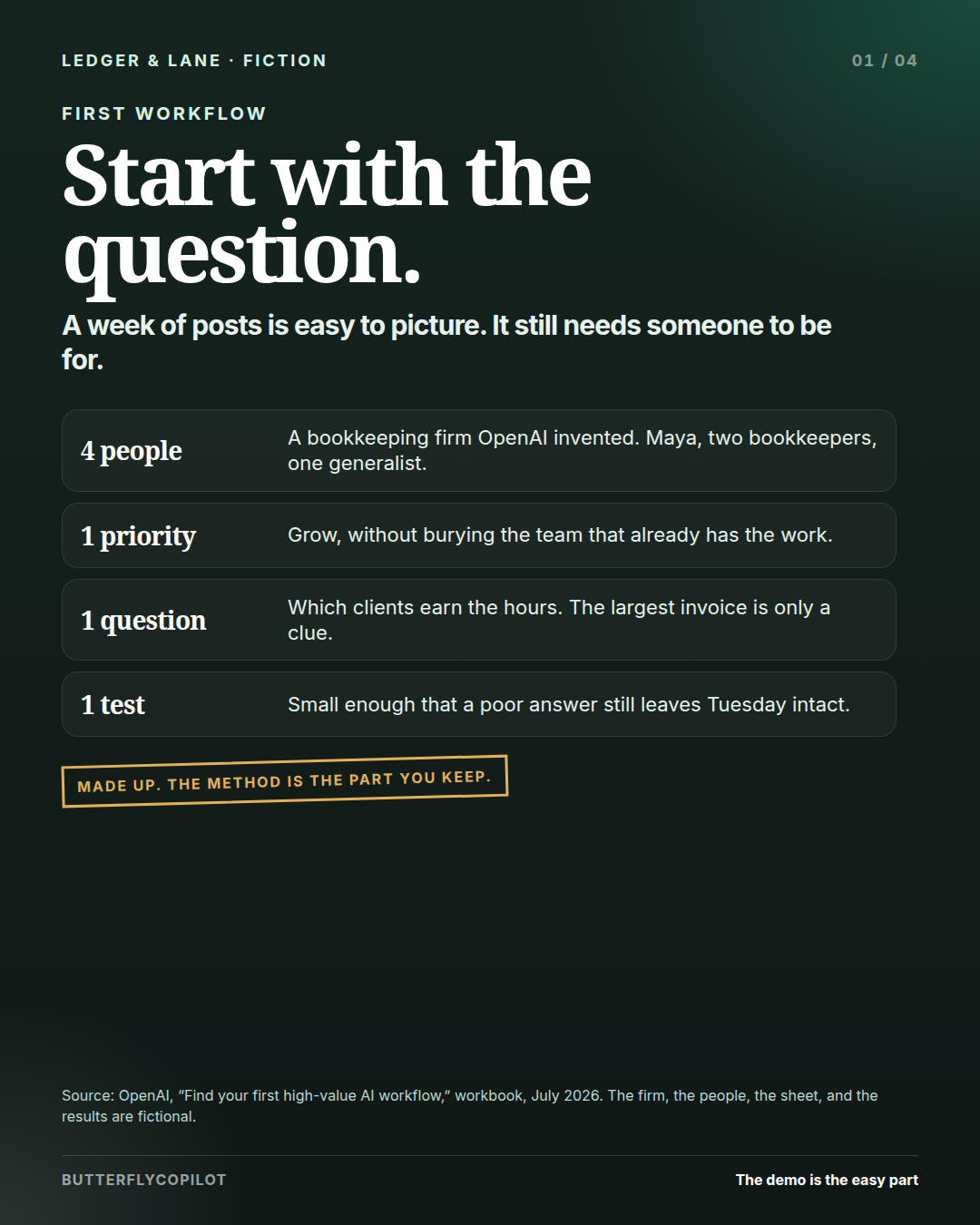
Ledger & Lane does not exist. OpenAI built the firm, and Maya, so that question would have a shop. She owns it. She still sells, and she still does the client work. Two bookkeepers keep the recurring accounts. An operations generalist runs the calendar, starts the new clients, and catches the messages that would otherwise land on her. They serve solo professionals, local service businesses, and growing small companies. Monthly books, tax preparation, payroll coordination, and a new advisory package she would like to sell to the right people.
New work is coming in. The week is already full. Revenue, she can see. Setting it beside who stayed, and beside how long the work actually took, is still a manual afternoon, because the rest of the picture sits in the invoices and in what she remembers about who was painful.
A post about the advisory package, sent toward the clients who already consume the week, makes the firm busier in a direction she has not chosen. So the posts wait. The first workflow is the comparison the posts were skipping.
The firm, the owner, the bookkeepers, the generalist, the spreadsheet, and anything the comparison “finds” are fiction. A workshop, a job shop, or a four-person plant can run the same week on files that are real. Ledger & Lane is the illustration. It is a poor template.
The sentence comes before the tool
A workflow earns a place when it moves a priority the business already has, inside the next month or the next quarter. Growth. The way a customer is treated. Capacity. Cost. Quality. Risk. When several of those are loud, pick the one that would change where the owner spends attention. Maya’s is deliberate growth, the kind that does not bury the team.
Under it sits the friction. Work that is slow, uneven, hard to look at, always late, or living in one person. Hers is the scattered picture. She wants to know which customers and which services deserve the limited hours. The client sheet already holds services, revenue, a rough estimate of team time, and retention. The invoices and her memory still have to be reconciled with it, by hand.
The sentence worth writing down is a business sentence. We are trying to see which clients are the best use of the team, and the comparison is scattered across a spreadsheet, the invoices, and one person’s memory. Leave the product out of it. “We need a tool to analyze clients” has already chosen a solution, and it has not yet said what decision that solution is for.
A fabrication shop slips in the same place. “We should put AI on quoting” names a product. “We are trying to fill the laser with work that pays for the hours, and every enquiry looks urgent, because the quote file does not show which customers came back and which jobs ate a shift” names a priority. Last month’s jobs can test the second sentence. The first sentence can only be demonstrated.
The decision stays a person’s. Maya defines what valuable means for the firm. A model can line the evidence up. The definition is hers, and so is the action that follows it.
A workflow is a path you already walk
Something starts the work. It uses particular information. It has steps, and a place where it slows down or comes out differently depending on who touched it. A person has to review or decide. There is an output someone will actually use.
That is a workflow. A clever instruction is one moment inside it.
Maya maps the job she already does when the growth question comes up.
It starts when she has to decide where four people should point the next quarter. The input is a client sheet: the services, the revenue, an estimate of team time, and whether the client stayed. Today she sorts by revenue, then corrects the ranking in her head, from the sheet, the invoices, and whoever was difficult in March. She checks the numbers. She checks the assumptions. She decides. The output she needs is a comparison of customer groups that shows the arithmetic, the assumptions, and the tradeoffs, and then stops.
A process map on the wall is optional. Enough detail to see where a model can help, and where the judgment has to stay, is the bar.
Five shapes of help are enough to build a list, and none of them is a product feature. Answer a question: explain, summarize, retrieve. Look at evidence: find a pattern, compare the options, offer a recommendation a person can throw out. Make a defined thing: an email, a brief, a page. Run a known process the same way whenever the trigger fires. Carry a longer job across several steps, with a person approving at the points that matter. A real workflow often mixes two of these. The list is for candidates. The winner comes later.
Across the firm’s week, Maya writes four.
Draft the weekly marketing.
Analyze which clients and which services are worth the hours.
Find the clients who might suit the advisory package.
Straighten onboarding.
She will compare them. She does not crown one in the same sitting.
A job shop’s four will look different and rhyme. Draft the replies to enquiries. Compare which job types earn the floor. Flag the customers who might take a maintenance contract. Rebuild the way a new supplier is set up. The pause is the same pause. The candidate that would look best on a screen is often the one that leaves the quarter’s question untouched.
Value on one axis. Readiness on the other.
Skip the weighted scorecard. Each candidate gets two questions, asked in the language of this business.
Does it serve the priority you named. Does it hit friction that actually recurs. Would a better version change time, quality, revenue, cost, or the way a customer is treated.
And: do you have representative information you are allowed to use. Is the output clear enough that a knowledgeable person can say whether it is good. Can that person review it. Can you try it without disturbing the week.
High value and ready is where the first test belongs. Ready, and aimed beside the priority, is an easy win to keep in a drawer. High value and unready is a note about what would make a fair test possible. Narrow the scope. Clean the inputs. Define the output. Name the reviewer. Test one step of the chain. Low on both can sit on the page and wait.
Maya’s page, still her fictional firm:
The analysis of client and service value goes in the start-here square. It speaks to the growth decision. She already has a spreadsheet worth using, and she already has the question.
The marketing drafts go in the easy-win square. Straightforward to try. Limited, until the firm knows which customers and which services it wants to talk about.
Finding clients for the advisory package is a growth idea that is early. She would first need a working sense of what a valuable client is, and what a good fit for the package looks like. That square says invest, so the idea becomes testable. It does not say the package was a bad thought.
Onboarding sits in the far corner for this quarter. The job is wide. It runs through several tools, and it touches the information that arrives with a new client. A narrower piece can wait until the comparison has told her which clients are worth onboarding faster.
She tests the analysis.
Draw the same page for a small plant and the labels move. “Chase every supplier” and “rebuild quoting” often land where Maya put onboarding. “Which jobs paid for the hours” often lands where she put the client sheet. The plants that have already chosen look like the neighbouring posts. Yat Guan, a pallet maker, turns an enquiry into a spec a salesperson can price, and the price stays with the salesperson. J4S put the chase inside WhatsApp groups a glass plant already used, and a commitment closes on proof. Little Farms let the invoices be read, and a person still approves the bill. Those are workflows after the picking. This week is the picking.
Small enough to undo
The first test answers one question. If the answer is disappointing, Tuesday still happens. Learning that a workflow is the wrong one, or that the information is not ready, is a result. It is how a quarter does not get spent scaling it.
Maya writes a card before anything runs.
Today she ranks clients by revenue and folds in team time and retention by feel. That is the baseline.
The test asks which kinds of clients look most valuable to the firm, beyond who sends the largest bill.
The input is the minimum the question needs. Customer groups, services, revenue, estimated team time, margin, and retention. In the story, that sheet is made up, because the firm is. On a real desk, take identifying detail off where you can. Leave out passwords, bank credentials, tax identification numbers, API keys, and any file you are not authorized to hand to a tool. A bookkeeping firm’s cabinet is other people’s accounts. A plant’s cabinet can hold a customer’s drawing and a supplier’s price. Company policy and professional duty still apply. A person reviews the result before anyone acts on it.
Then the test itself. The model checks the sheet, asks what is missing, and compares the groups. It shows the calculations, the assumptions, and the tradeoffs. It does not pick the clients.
Maya reviews. She checks the arithmetic and the context. She decides what valuable means. A good result is accurate, the assumptions are on the page, and the same approach could be run again. A strategy memo that quietly made the decision is a bad result, however tidy the paragraphs.
Afterwards she will adopt the analysis, refine it, widen it, pause it, or stop.
A connection to another tool can help a later version, when that tool holds context the work actually needs. The first pass can be a file she uploaded, or a bounded example. Add a connection after the workflow has proved useful. Only a connection a person has approved. Only the one this workflow requires.
A fabrication shop’s card is the same five lines, on a real export. Baseline: Friday night, jobs ranked by the invoice. Question: which job types paid for the hours and the material, and which only looked large. Inputs: jobs, hours, material, and whether the customer ordered again, with the names taken off, a short stack of rows she will actually read. Reviewer: the owner, against the jobs she remembers, including the one the export describes too kindly. Afterwards: keep the Friday comparison, fix the export, or stop. The quoting system stays where it is until this pass has earned a second conversation.
One step, then look again
A test that came out well is evidence about one piece of the work. It is a reason to repeat that piece, improve it, or hand its result to the next decision. It is a poor reason to automate the firm.
Maya’s comparison can open a loop, and only the first turn of one.
The workflow names customer groups and services that appear to earn the hours.
She checks it, and she decides which of those insights are real.
When she approves an opportunity, a short brief or a draft can be prepared for that audience. She reads it before it is used. Nothing goes out on its own.
Replies, conversations, and the work that actually converts show which of those opportunities had substance.
That learning goes back into the next comparison.
Look, then a person reviews, then a person acts, then the firm learns, then the analysis runs again. Each pass should make the next decision a little less blind. People still choose what enters, what the output means, and which actions are allowed to leave the building.
Before a step is added, look at the last one. Did anyone use the result. Did the work or the decision get better. Is the next input clear, and is it actually available. Who will review and approve the next output. Can the step be added and still be understood on a Monday, and removed on a Tuesday. Start with a rhythm where the model prepares the analysis or the draft and a person decides what happens. Wider automation is a later argument, after the workflow is reliable, useful, and still supervised.
When it holds up, write down the instructions, the inputs, and the review points, so the next run does not depend on Maya remembering how she asked. If tools the firm has already approved can run on a trigger, the next analysis or brief can arrive for someone to sign. That is when a test starts to feel like an extra pair of hands, and the owner gets a morning back. Saved too early, the same file just repeats the first mistake on a schedule.
Three signals are enough to decide whether the loop deserves to continue. Are people using it. Is the work faster, steadier, or the decision better. Does it move the priority named at the start. A handful of numbers you would be willing to argue from will do. If the sample was small, if something you called success did not happen, or if an assumption the decision rests on was never tested, the honest next move is to refine, pause, or stop. Widening the workflow would hide the gap.
What the week leaves on the desk
A short list of workflows, taken from work the business already does.
A plot of value against readiness. A judgment, with the reasons in sentences. No invented decimals.
One workflow, chosen for a first test.
A card: the baseline, the question, the minimum inputs, the reviewer, and what a good result looks like.
A decision. Adopt, refine, expand, pause, or stop.
If you continue, one small next step. The operating system can wait.
You do not need a finished data room before the first conversation. It helps to have a short description of the business and its customers, the priority for this quarter, one example of the recurring work, files you are allowed to use, the tools and the duties that constrain you, a rough account of how the work happens today, and the name of the person who will review. Gaps can show up as you go. They should show up before a bank feed or a customer inbox is connected.
Download the workbook and run it on your own floor
Ledger & Lane was a way to watch the sequence with the names filled in. Your customers, your files, and the decision only you can make are the point. OpenAI’s workbook, Find your first high-value AI workflow, is written for small businesses to use with ChatGPT Work. The prompts are in the file. They ask a few questions at a time, and they wait. Download it and run them on your business. Keep the first test small enough to undo.
The method does not depend on one model staying put. What a workspace can connect, and how an uploaded file is handled, will change. Before you start, confirm which features you actually have, whether an administrator has approved the connection, how that information is treated, which company policies and professional duties apply, and who reviews anything that would spend money, send a message, or change a record. The workbook’s closing pages point at OpenAI’s current guides for those checks. Use the current ones.
Download the workbook (PDF)
Sources
Ledger & Lane, Maya, the bookkeepers, the generalist, the client sheet, and every placement on the quadrant are OpenAI’s fictional example. They illustrate a method. They are not a result, and they are not a forecast for a bookkeeping firm or a plant.
- OpenAI, “Find your first high-value AI workflow,” workbook PDF, July 2026. An interactive workbook for small businesses, written to be used with ChatGPT Work. Ledger & Lane is a fictional four-person bookkeeping and accounting practice. Maya leads client work and sales. Two bookkeepers manage recurring accounts. An operations generalist handles scheduling, onboarding, and client communications. Clients in the story are solo professionals, local service businesses, and growing small companies. Services are monthly bookkeeping, tax preparation, payroll coordination, and a new advisory package. The workbook says the company, the people, the data, and the results are fictional. The sequence on this page is the workbook’s method: one priority for the next 30 to 90 days, the recurring friction behind it, a map of what starts the work, what it uses, where it slows, what a person must decide, and what output matters, five ways a model can help, a comparison of business value and delivery readiness, a small reversible test, and a decision to adopt, refine, expand, pause, or stop. The loop it describes runs from analysis to review, to an action a person approves, to what the market did, and back into the next analysis. The workbook says its resource links were reviewed in July 2026, and that the method does not depend on a particular model. This page does not include the prompts. They are in the PDF, for a reader to run on their own business.