
How WP Kemper Found Drawing-Part Savings with AI Agents
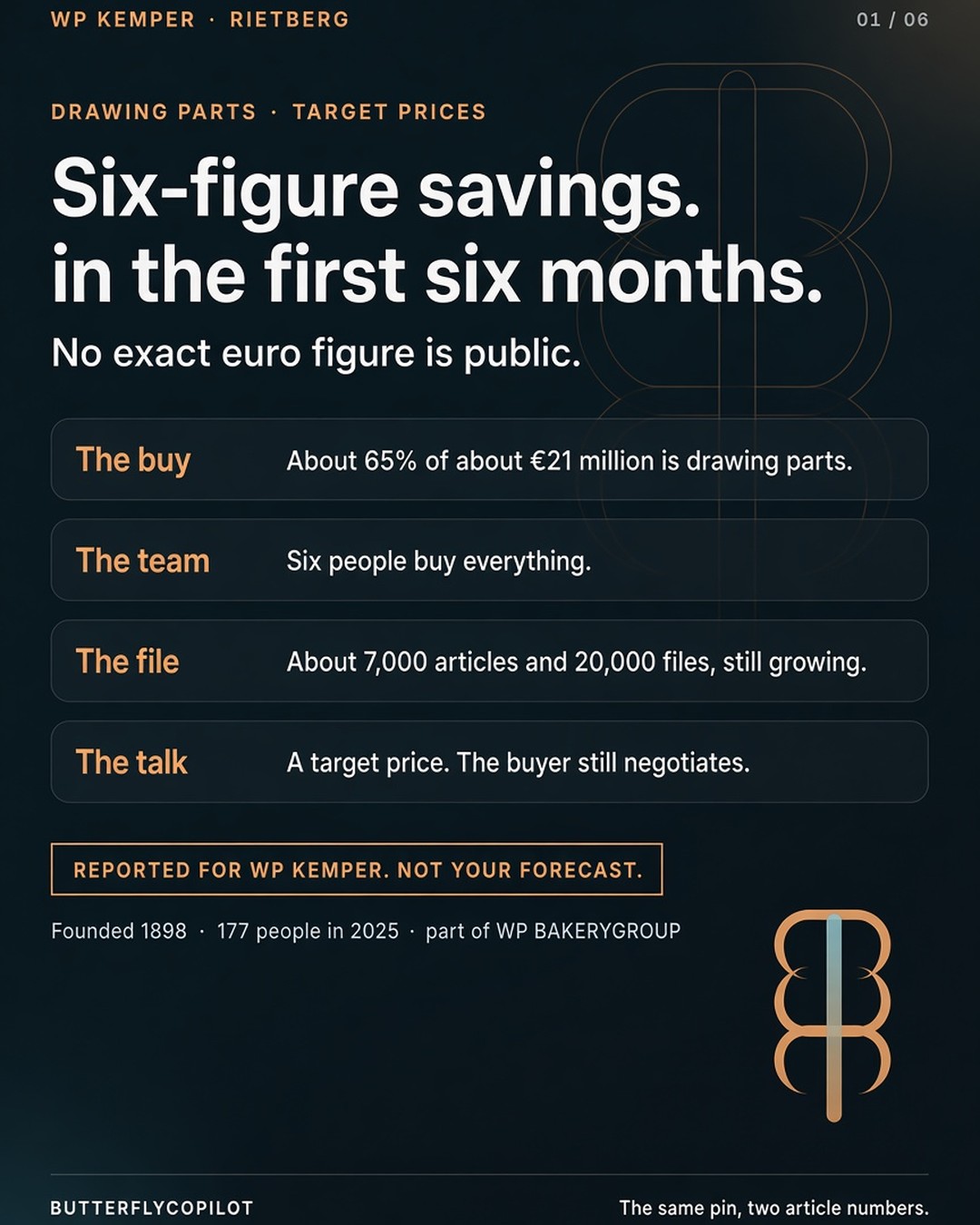
Six buyers, thousands of one-off drawing parts, and the same pin hiding under two article numbers. The negotiation still belongs to a person.
ButterflyCopilot
0106
The pin on one drawing and the pin on another were the same pin. The article numbers were not.
WP Kemper builds the machines that make the dough, and the lines that turn it into bread, rolls, and donuts. The works are in Rietberg. The firm started in 1898, turned 125 in 2023, and in 2025 had 177 people, 17 of them apprentices. It has been part of WP BAKERYGROUP since 2003. Almost every line is laid out for one customer, down to the parts.
Those parts are the purchasing problem. Turned, milled, stainless, steel, plastic. About 65 percent of a purchasing volume of about €21 million. Six people buy all of it. Thousands of different parts, most of them not ordered the same way twice, and a raw-material price that will not sit still.
The drawing knew, and the buy did not
Operative purchasing was already largely digital, and already had AI in it. The drawing-part buy was still a person with a PDF and a STEP file. Geometry, tolerances, the surface, and the process sat in those files. They were not rows. A pin bought in February could come back under a new article name, and the buyer would research it as if the plant had never held one. A price comparison, a benchmark, a second supplier: each one was a search.
The project is called Agentische Analyse und Zielpreise bei Zeichnungsteilen. It is their own build, shaped for this job. No product name is public.
They put the ERP, the drawing, the supplier, and an external market and price series into one database. About 7,000 articles and about 20,000 files are in it so far. It is still growing.
Agents read the drawings. They find the identical part and the similar part from the geometry, the tolerance, and the surface, which is how a bundling chance stops hiding behind two names. They flag a price that has moved out of line, a cheaper source for the same part, and a raw-material index that has moved. When a negotiation is coming, they assemble the order history, the comparison parts, the benchmark, and a target price.
They started with one key user. The rest of the purchasing team came after, with time set aside, training, and tuning that does not stop. The hints get sharper as the file gets larger.
In the first six months the negotiations produced six-figure savings. The research a buyer used to do by hand got considerably smaller. The information shows up before anyone goes looking, and the talk is prepared with a target and the argument for it. A dependency on one supplier is easier to see, and a second source can be started while there is still time.
The exact euro figure is not public. Six-figure savings in the first six months is the published result. It is not a number this page will invent.
Jens Helbig, Leiter Einkauf, put the point of the work in one place.
With autonomous AI agents we are taking digitalisation in purchasing to a new level. Especially given the high complexity of individual drawing parts, this opens entirely new possibilities for data-based and forward-looking purchasing. For us, innovation means not only using new technologies, but integrating them consistently into the purchasing work and creating measurable value for our company from that.
The BME gave the project the Procurement Excellence Award for small and mid-size companies, on 18 November 2026, at the symposium in Berlin.
Articles, purchase orders, the supplier master
PDF and STEP, plus a raw-material index the plant has filed
        ↓
The model copies the ink. The kernel measures the solid. A person accepts what is weak
        ↓
Identical or similar, in code, with the reason on the row
        ↓
A benchmark, a should-cost, and an ask that cites the benchmark
        ↓
A person walks into the talk. The agent does not write to the supplier
The boxes are the instruction file. They follow the shape of the job: one database, a reading of the drawing, a match a person can check, a target with a formula, a negotiation that stays with the buyer. They are not a reconstruction of WP Kemper's screens. The model name, the prompt, the CAD kernel, and the index provider are not public. This page does not invent them.
A similar shape is not a cheaper supplier
Speed is how an agent calls two parts the same because the titles look close, treats a missing steel index as last month's index, and books the gap as money already saved. Speed is how the cheapest old order becomes the target, and how a target becomes an email the supplier has already received. Speed is how a six-figure result slides into the config of a plant that has not measured anything yet.
The file for a smaller machine builder keeps the jobs and drops the tenant. One key user. One part family. The bands, the confidence line, and the match thresholds are numbers the plant types, because WP Kemper does not publish them and they must not be guessed. The model may copy ink off a drawing. It may not decide that two parts match, and it may not decide a cent. It may not write to a supplier. It may not change a price or a supplier. Version 1 writes files. A brief is not a sent message. An identical group is not a new vendor.
On the fixture, which is ours, three pins share a solid. Two spellings of one supplier are one supplier. A third pin, identical and cheaper, sits on a blocked supplier: it stays visible in the group, and it is not the target. A quantity of 100 does not get compared with a quantity of 20. A July line with no index does not borrow June. The should-cost on the main pin is lower than the benchmark of three real buys, and the ask is the benchmark. The shaft that moved by 20 cents is inside both bands, so it gets no brief, even though a cost model exists and the pin has no peers to compare. Identified cents on the two briefs are 5,200. A person then files the price that was actually agreed, on the same quantity, and negotiated cents are 2,000. The file does not add them. The bundle of identical pins is 160 pieces of potential and zero cents, until someone renegotiates a real order.
technotrans, in Sassenberg, is the purchase-order desk on this site: one price file, a watch on a rise, a consolidation a person still owns. Kuken finds the sheet. Shin Zu Shing reads the balloons into a checklist. This desk reads the solid so a buyer can see the same part under another number, and can walk in with a target that still has a formula. The €409,556 on that page, the 4.5 minutes on the search page, and the 20 minutes on the checklist page stay on those pages.
What a smaller manufacturer should steal
If the same pin still has two article numbers, and the buyer can already point at the PDF, the first month is one key user and one part family. Turned steel is the starting family in the file. That choice is ours. The case names turned, milled, stainless, steel, and plastic. It does not say which folder they opened first.
One key user, one family, thresholds you type yourself
        ↓
Thirty days of drawings a person already knows, and a signature on every weak field
        ↓
Thirty days where the brief sits beside the note that buyer would have written
        ↓
Thirty days where an accepted brief may be taken into a call the buyer places
        ↓
The supplier does not change inside the tool. The next family waits.
Count the stretch you already have. Minutes from a drawing in hand to a talk, on a clock you started before the tool existed. How many matches the key user accepts, and how many they throw out. How many briefs they use unchanged, how many they edit, how many they kill. Identified cents and negotiated cents, both, beside the sheet the buyer already keeps. Lines held because an index, a material, or a solid was never accepted. Messages this agent sent. Suppliers it switched. Prices it wrote back to the ERP. Identified cents that leaked into the negotiated column. Those last four stay at zero.
The six-figure savings, the 65 percent, the €21 million, the six people, the 7,000 articles, and the 20,000 files are WP Kemper's published story. They are not one equation, and they are not a line for a proposal. The exact euro amount is not public. Do not paste a guess onto yours.
What the instruction file will make an agent do
The file below is the brief. It is not their ERP, their thresholds, or their approval screen. None of that schema is public. The blanks are yours.
It will make the agent:
- Refuse to run while a
REPLACEline is empty, or while anEXAMPLErow is still in a live sheet. Refuse a savings target, and refuse the case figures as a setting. - Build one supplier from an exact key. The two spellings of Stahl Nord become one. The two Müller rows, with two tax ids, do not.
- Copy the ink with a model and measure the solid with a CAD kernel. Parse the material, the tolerance class, the roughness, and the process in code. Leave a confidence below the line the plant typed for a person. Leave a failed solid as null, not as a volume of zero.
- Match on the predicates. The three identical pins match. The far pin does not. A blocked price stays out of the benchmark and out of the alt, and the part stays in the group so the buyer can see it.
- Brief the pin whose index-adjusted price sits outside the band of the three-peer benchmark. Leave the shaft alone. Keep the should-cost on the brief and do not let it undercut the benchmark. Write no brief when the only number on file is a cost model with no peers.
- Count 5,200 cents as identified and 2,000 cents as negotiated when a person files the price that was agreed, on the same quantity. Show them apart. Give the quantity change a saving of zero. Leave the bundle at zero cents.
- Accept a brief for a negotiation only from the named key user, on the form. There is no send. Accepting does not change the supplier and does not write the price.
The tests are in the file. The two spellings that are one supplier. The two tax ids that are not. The blocked twin that is not the target. The 20 cents that get no brief and the gap that does. The 5,200 and the 2,000 that are not a sum. The card number that never appears. If the agent clears any of those by matching a title, emailing a supplier, adding the identified gap into the saving, or switching a source, the test fails.
The instruction file
The brief has the role, the sheets a purchase-order export and a drawing folder can fill, the PDF read, the STEP measure, the match, the index, the should-cost, the brief, the bundle, the ledger, the approval gates, the ninety days, and the tests that decide when a file may be treated as a note a buyer has not yet used.
Replace every REPLACE line. Delete every EXAMPLE row. Let it sit beside one family's drawings for a month a person still finishes by hand, before anyone treats a brief as a price the supplier has already been given.
Sources
The company facts in the story are from WP Kemper's history page. The purchasing work, the award, the six-figure savings, and Jens Helbig's sentence are from the BME release. Beschaffung aktuell carried the same award on 20 November 2026. The blockquote above is an English rendering of his German sentence. The German is the source. No exact euro amount appears in either account. None of this is a forecast for another manufacturer.
- BME, 18 November 2026, "Mit KI zu Transparenz und Einsparung: WP Kemper erhält den BME Procurement Excellence Award 2026." WP Kemper GmbH, Rietberg, part of WP BAKERYGROUP. Customer-specific bakery machines and lines. Drawing parts — turned, milled, stainless, steel, and plastic — about 65 percent of a purchasing volume of about €21 million. Procurement run by six people. The project „Agentische Analyse und Zielpreise bei Zeichnungsteilen“. Their own approach: a database linking ERP, drawing, and supplier data with external market and price data, about 7,000 articles and about 20,000 files so far. Agents read drawings, find identical and similar parts, flag price gaps, alternative suppliers, and index moves, and assemble order history, comparison parts, benchmarks, and target prices. Rollout from one key user to the purchasing team. Six-figure euro savings in negotiations in the first six months. Jens Helbig, Leiter Einkauf: „Mit autonomen KI-Agenten heben wir die Digitalisierung im Einkauf auf eine neue Stufe. Gerade bei der hohen Komplexität individueller Zeichnungsteile eröffnen sich damit völlig neue Möglichkeiten für einen datenbasierten und vorausschauenden Einkauf. Für uns bedeutet Innovation, neue Technologien nicht nur einzusetzen, sondern sie konsequent in die Einkaufsarbeit zu integrieren und daraus messbaren Mehrwert für unser Unternehmen zu schaffen.“ Awarded at the Symposium Einkauf und Logistik in Berlin.
- Beschaffung aktuell, 20 November 2026, "WP Kemper erhält den BME Procurement Excellence Award 2026." The same project and the same published results, following the BME account.
- WP Kemper, "Historie." Founded 1898. Factory in Rietberg. Part of WP BAKERYGROUP since 2003. 125th anniversary in 2023. 177 employees in 2025, of whom 17 were apprentices.