
How RH Electronics Cut PO Confirmation Work with AI Agents
The purchase order was already named. Three days of cutting Excel into supplier email became one distribution. A date the reply does not contain still does not get loaded.
ButterflyCopilot
0106
The row was already an order.
RH Electronics, the RH Group, builds other companies' electronics. The group was established in 1984. Its own site calls it the leading contract manufacturer in Israel, and the 2023 line on its timeline counts four locations and over 1,100 people. The work runs through medical devices, homeland security and aerospace, semiconductors, and green tech. The address on the site is Ha'Zoref 4, Nazareth Illit.
What stops a line is the part that has not arrived. Evolinq's account of the buying desk is a team of 35 procurement and import/export staff, more than 1,000 suppliers, more than 15,000 unique SKUs, and 25,000 active purchase-order lines. Procurement is about 70% of the cost. That account places the suppliers in Israel, Romania, and the United States. The group's own timeline puts a US site in 2004 and a European site in 2017.
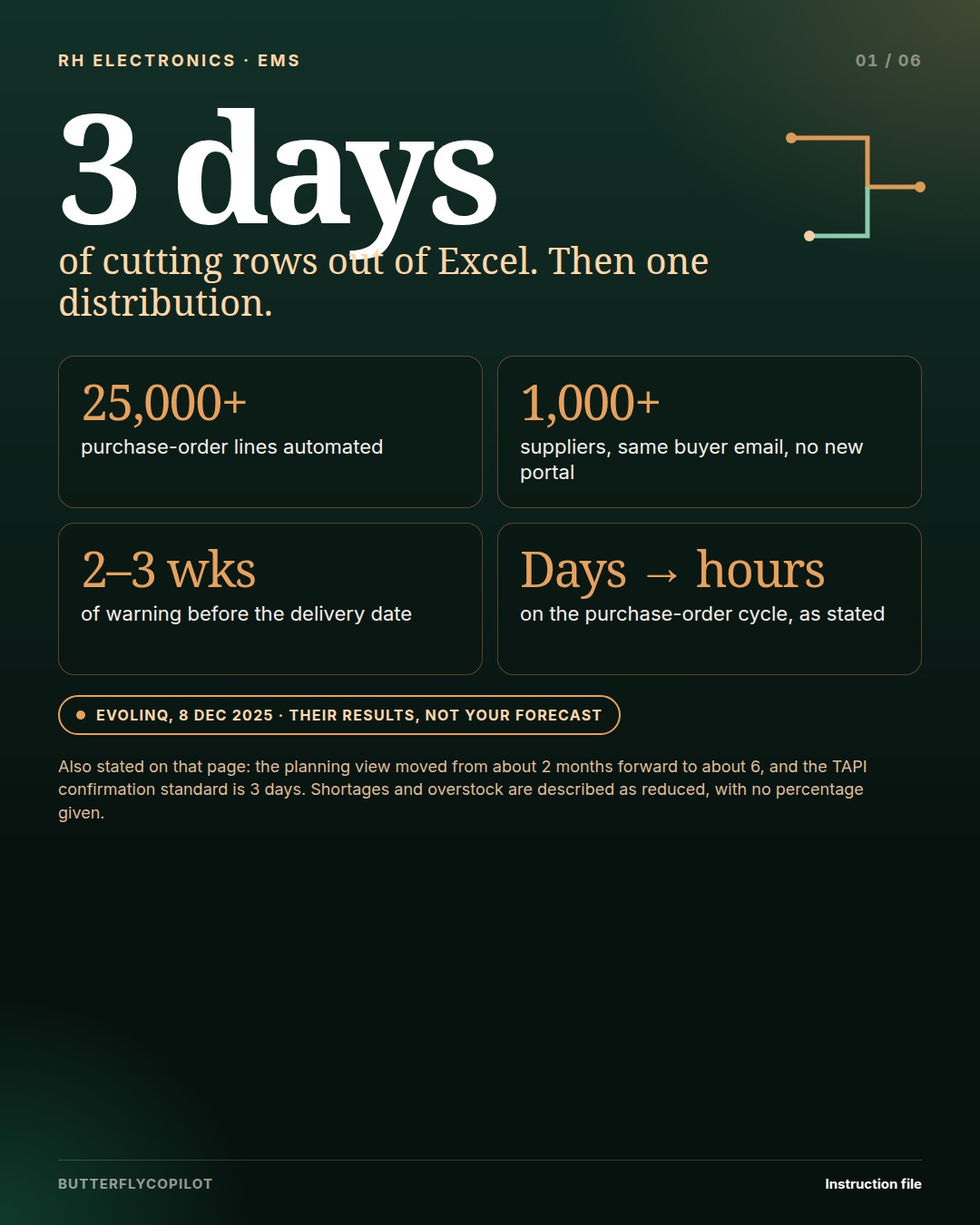
Erika Abelis, the purchase manager, described distribution on a large project as about three days of manual work. A buyer cut the rows out of Excel, supplier by supplier, and pasted them into email. The replies came back in whatever shape the supplier used, and someone typed the dates into the ERP. The write-up's picture of that entry is 7,000 rows, with the wrong date getting in, or the update never arriving at all.
For a single-source component there is often nowhere else to buy the part. A miss can stop production. With some customers, Erika said, it can bring a penalty.
What they stood up
They set a month aside. Evolinq's account says full deployment took a week. The agents send the open lines to the right supplier, in one standard note, on the buyer's behalf. There is no portal. The sentence worth keeping is Erika's. From the supplier's side, the email still came from the same buyer.
A reply can be a spreadsheet, a PDF, or the text of the mail. The agent reads it and pulls the confirmation, the delay, the price change, and the exception. Confirmed data is loaded into the ERP. That page describes the core path as not needing a deep integration. When a supplier flags a delay, the buyer hears about it two to three weeks before the delivery date, instead of on the day the dock is empty. The purchase-order cycle, as that page states it, shortened from days to hours. The distribution view stretched from about two months forward to about six. For the TAPI delivery confirmation, the standard they state is three days.
The operational team in that account watches about 2,000 of the 25,000 lines. Buyers stay on the roughly 5 to 10 percent that are real exceptions. Shiri Ashton, the operational purchase team leader, called the old work Sisyphean. With the system, day and night. Shortages, delays, and overstock are described as reduced. The page does not put a percentage on those three, and this one will not invent one.
Amir Eliyahu, the CEO in that account, treated the 70% as the reason the work mattered.
Open lines, already named, grouped by the supplier who makes them
        ↓
One note per supplier, from the buyer that supplier already knows
        ↓
The reply comes back as a spreadsheet, a PDF, or mail
        ↓
A clean confirmation can load. A price change cannot
        ↓
A delay alerts the buyer while the need-by date is still ahead
In October 2026, Tal Rozenberg, CEO of RH Group, described agents that sit inside Excel, the file the buyers already had open, on the D&D Strategic Impact podcast. Time spent on tactical supplier follow-ups fell by more than 60%. Supplier past-dues improved by over 40%. Confirmed order lines rose by 15%. He was talking about a group that runs more than 15,000 SKUs, 25,000 active purchase orders, and over 1,000 suppliers, with sites on three continents. Those three percentages are that interview.
The figures in both accounts belong to this company and to the people who stated them. A plant with a shorter book does not inherit them by switching a tool on.
A date the reply does not contain
Speed is how a tidy agent invents an email the contact sheet does not have, reads 11/26/2026 as 26 November because that is what someone meant, accepts 2.75 because the quantity was right, and overwrites a date a planner already locked because the new mail is newer. Speed is also how the note leaves from a shared mailbox, and the supplier, who was supposed to keep hearing from the same buyer, hears from someone else.
The file for a smaller plant keeps the path and drops the tenant. One buyer. One cohort of suppliers that buyer already writes to. The send list is hashed. The buyer approves that exact set, and adding a line after the approval voids the send. The message leaves from that buyer's own address, on the company's domain, or it does not leave.
On the fixture, five open lines are the send. Three of the four that nobody has confirmed by hand come back clean. That is 7,500 basis points, three quarters of a four-line set. It is this file's arithmetic on four made-up lines. A quantity of 60.00 against an open 100.00 is a partial. The other 40.00 stays open. It is not closed, and it is not turned into a second line. A price of 2.75 against a stored 2.50 is an exception, and the stored price stays 2.50. A human-confirmed 9 November is not replaced by 16 November. A promise of 28 December against a need-by of 15 December is an alert: 40 days of warning before that need-by, a slip of 13 days, and no draft. A need-by of 20 October, already past on the fixture clock, is counted at minus 16 days. It is not rounded up to zero. A date written 11/26/2026 stays unparsed. The agent does not help it along.
Footprint chases the acknowledgement on a purchase order the material plan already named. FABco keys the bill of lading and matches the invoice. AGC Chemicals and KOEPFER go looking for a supplier and a price. This desk already has the supplier and the order. It sends the lines, reads the reply, and will not invent the date the text does not contain. The price, and the payment, stay with a person.
What a smaller plant should steal
If the buyer already knows who makes the part, and the week still disappears into copy and paste, the first ninety days are one buyer and the suppliers that buyer already emails.
RH is the useful size of example for the volume. A contract manufacturer, a long supplier list, a team that still has to see the exception. The lesson is that the distribution and the reading can move, and a date that is wrong stays in the room with a person. The supplier should not be able to tell that anyone new is in the thread.
One buyer, the suppliers that buyer already writes to
        ↓
Thirty days of exports, and a stopwatch on the distribution you already run
        ↓
Thirty days of mail from that buyer's own address, after the list is approved
        ↓
Thirty days where a clean confirmation may write the draft, and a delay may not
        ↓
A second cohort waits. A price change still waits.
Time the stretch you already have. Hours from the export in hand to a send you would actually release. The share of lines that come back confirmed without anyone retyping them. The days of warning on a slip, on your own clock, including the ones that are shorter than two weeks. The past-due count, with the minus sign kept when a line is already late. Messages sent from any address but the buyer's. Prices the agent accepted, human dates it overwrote, payments it released. Those last counts stay at zero.
RH's scoreboard is not your forecast. The three days, the 25,000 lines, the 1,000 suppliers, the two-to-three-week warning, the days-to-hours cycle, the move from about two months to about six, and the interview's more than 60%, over 40%, and 15% are this company's published story. Measure your own hours, your own confirmations, and your own exceptions. Do not paste their numbers onto a proposal.
What the instruction file will make an agent do
The file below is the brief. It is not Evolinq. It is not RH's ERP, which neither the case study nor the company site names. The blanks are yours.
It will make the agent:
- Refuse to run while a
REPLACEline is empty, or while anEXAMPLErow is still in a live sheet. - Take one buyer and one supplier cohort. A line for someone else, a closed line, a supplier with no purchasing email, and a need-by past the horizon the plant typed stay off the send. An accounts-payable address does not fill in for a blank one.
- Hash the exact set. Send only after that buyer approves it, only from that buyer's own mailbox, and only once the send flag is on. A follow-up lists the lines still waiting and stops at the chase cap. It does not negotiate.
- Read one CSV header and two sentence shapes.
100is not read as 100.00.11/26/2026is not rewritten into an ISO date. A date that exists only inside an unread PDF stays missing. - Treat a price that differs from the purchase order as an exception. On the fixture, 2.75 does not replace 2.50. A short quantity does not close the line. A date after the need-by becomes an alert, with the warning counted in days, and it does not post. There is no rule that hides an alert unless it falls inside two to three weeks.
- Leave a human-confirmed date where it is. The rule is that this agent does not overwrite one. There is no second switch.
- Write a morning file from this plant's own hours, its own confirmation share, its own warning days, and its own past-due count. No comparison with either published scoreboard.
The tests are in the file. A send from a shared alias on the right domain that does not leave. A fifth line added after approval that voids the send. A partial of 60.00 that leaves the open 100.00 untouched. A second reply that disagrees and pulls an unposted draft back. A card number that is not copied into the note. If the agent clears any of those by inventing an email, accepting the price, or posting the late date, the test fails.
The instruction file
The brief has the role, the sheets a spreadsheet or an ERP export can hold, the path from distribution to the alert, the date grammar, the hash, the chase, the exception routes, the mapping sheet for whatever ERP the plant already runs, the ninety days, and the tests that decide when a buyer may let a message leave.
Replace every REPLACE line. Delete every EXAMPLE row. Let it sit beside one cohort a person still confirms by hand, before anyone treats a file as an email the supplier has already been sent, or as a date the ERP has already accepted.
Sources
The distribution path, the three days, the line counts, the 2–3 week alerts, the days-to-hours cycle, the horizon, the TAPI standard, the team size, the 70%, the 5–10%, and the sentences from Erika Abelis, Shiri Ashton, and Amir Eliyahu are from Evolinq's RH Electronics case study of 8 December 2025. The body of that page says a month was allocated and full deployment took a week. The same page also prints a couple of days and two weeks. This article uses the body's month-and-week sentence and does not average the three. Shortages, delays, and overstock are described there as reduced, with no percentage. The more-than-60%, the over-40%, and the 15% are from Tal Rozenberg's 7 October 2026 interview, and they are cited from that interview alone. The year, the 2023 headcount and locations, the sectors, and the address are from RH's own site. The figures are as those pages report them. They are not an independent audit, and they are not a forecast for another plant.
- Evolinq, Noam Shakuri, "How RH Used AI Agents to Enable Autonomous Procurement," 8 December 2025. RH Electronics, described as one of Israel's largest electronics subcontractors, with suppliers across Israel, Romania, and the United States. More than 15,000 unique SKUs, 25,000 active purchase-order lines, 1,000+ suppliers, 35 procurement and import/export staff, procurement about 70% of costs. Erika Abelis, Purchase Manager, on about three days of manual distribution for large projects, on suppliers still receiving email from the same buyer, and on single-source parts. Manual entry across 7,000 rows. Shiri Ashton, Operational Purchase Team Leader, on work that could take hours or days, and on the change. About 2,000 active lines watched by the operational team, out of 25,000. Buyers on the roughly 5–10% with real issues. Distribution to a single action. Replies read from Excel, PDF, or email. Confirmed data loaded to the ERP. The page says the core path did not need a deep integration. Delay alerts 2–3 weeks before the delivery date. Cycle time from days to hours. Planning horizon from about 2 months to about 6. A 3-day TAPI confirmation standard. Shortages, delays, and overstock described as reduced, without percentages. Amir Eliyahu is the CEO named in this account. The page prints the deployment as a month allocated and a week to full deployment, and elsewhere as a couple of days and as two weeks.
- D&D Strategic Impact, "60% Time Saved by Fixing the Process Before AI," 7 October 2026. Guest Tal Rozenberg, CEO, RH Group. The notes call the group Israel's leading contract electronics manufacturer, serving medical devices, aerospace, defense, and green tech, with more than 15,000 SKUs, 25,000 active purchase orders, over 1,000 suppliers, and sites on three continents. Agents that work inside Excel cut buyer time on tactical supplier follow-ups by more than 60%, improved supplier past-dues by over 40%, and increased confirmed order lines by 15%. Those three percentages are this interview.
- RH Group, rh-global.com and the about page. Established in 1984. The site calls rh the leading contract manufacturer in Israel. Sectors named on the about page include medical, homeland security and aerospace, semiconductors, green tech, digital printing, and food tech. Address on the home page: Ha'Zoref 4, Nazareth Illit. The 2023 timeline line: four locations worldwide and over 1,100 employees. rh USA is the 2004 line. rh Europe is the 2017 line. The home page says the group runs a unified ERP across sites and does not name the product. The address is not a result of the agents.
- Agent Use Case Index, reviewed 16 October 2026, repeats the Evolinq account, including the move from about three days to one click, the 25,000+ lines, the 2–3 week alerts, and a one-week deployment against a planned month. It is not an independent count.